How to Use the Shoemaker-Levy 9 Jupiter Impact 3D Explorer - Step by Step
Open the Shoemaker-Levy 9 Jupiter Impact 3D Explorer, press Play or drag the timeline slider, then read the facts panel to see the real published date and figures at each 1992-1994 milestone.
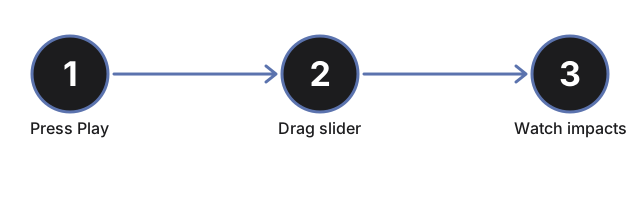
Press Play or drag the timeline slider
Press #t3dSl9PlayBtn to auto-advance through the real 1992-1994 timeline, or drag #t3dSl9Progress (0 to 100) to jump straight to any point. Dragging the slider pauses auto-play.
Read the milestone table
The facts panel lists all 13 real milestones - the 1992 tidal breakup, the 1993 discovery, and 11 individually dated fragment impacts - with the currently active one highlighted. Scrub the slider and watch the highlighted row change to match.
Watch the fragment train strike Jupiter one at a time
Each time the timeline passes an impact milestone, that fragment marker disappears and a dark scar appears on Jupiter's southern hemisphere. By 100% progress, all 11 named fragments have struck in their real July 1994 order.
Compare Fragment G's scar against Earth
Scrub past 40% progress to reach Fragment G, the largest impact. Press #t3dSl9EarthBtn to draw a circle matching Earth's real diameter beside Jupiter, so you can compare it directly against Fragment G's real scar size.
Click Jupiter, a fragment, or a scar
Click any object in the scene to refresh the facts panel with the current milestone without moving the slider.
Drag to orbit and use fullscreen
Drag to orbit the camera, scroll or pinch to zoom, and use the Fullscreen button to expand the whole wrapper for a clearer view of Jupiter and the fragment train.
Next: see when to use this explorer or how it compares to the DART Asteroid Deflection 3D Explorer.
Why trust these tools
- Ten-plus years of web tooling. The freetoolonline editorial team has shipped browser-based utilities since 2015. The goal has never changed: get you to a working output fast, without an install.
- No install, no sign-up. Open a tool and get a working output in seconds - nothing to download and no account to create. Tools that need heavy processing run it on our service, so even a low-powered machine gets the job done.
- Analytics stops at the page view. We measure which pages get visited, not what you type or upload inside a tool. There is nothing to sign in to and no profile is attached to your input.
- Open-source core components. The processing engines underneath (libheif, libde265, pdf-lib, terser, clean-css, ffmpeg.wasm, and others) are public and audit-able. We link to each one in its tool page's footer.
- Free, with or without ads. All tools are fully functional without sign-up. The Disable Ads button in the header is always available if you need a distraction-free run.