Rosetta + Philae 67P 3D Explorer vs Hayabusa2 Ryugu Sample Return 3D Explorer
freetoolonline.com editorial teamBoth pages scrub a real small-body mission's timeline in one page load - 0 MB installed, USD 0, no account. The Rosetta + Philae 67P 3D Explorer covers a spacecraft that landed directly on a comet and stayed there; the Hayabusa2 Ryugu Sample Return 3D Explorer covers a different spacecraft that touched an asteroid just long enough to collect samples and bring them back to Earth.
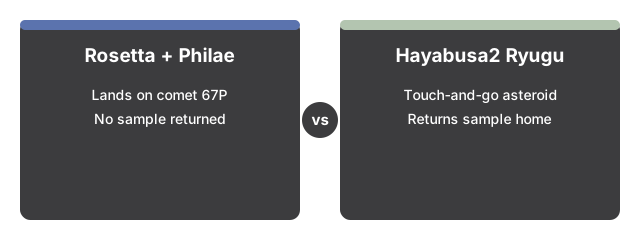
The numbers side by side
| Aspect | Hayabusa2 Ryugu Explorer | Rosetta + Philae 67P Explorer |
|---|---|---|
| Install size | 0 MB - runs in the browser | 0 MB - runs in the browser |
| Price | USD 0 | USD 0 |
| Body approached | asteroid Ryugu, diamond-shaped, about 1,004 m equatorial diameter | comet 67P, two-lobed contact binary, about 4.1 km along its longest axis |
| Real mission span shown | 2014-2020 (about 6 years) | 2004-2016 (about 12 years) |
| Surface technique | 2 brief touch-and-go contacts, firing a projectile to collect loose material | 1 lander (Philae) deployed to stay on the surface - though it bounced when its anchoring harpoons failed |
| Sample returned to Earth | yes - about 5.4 g landed near Woomera, Australia, 2020-12-06 | no - Rosetta and Philae stayed at the comet; no material was brought back |
| How the mission ended | capsule returned to Earth; the spacecraft itself continued on an extended mission | Rosetta made its own controlled descent onto the comet's surface, ending contact |
Where the Hayabusa2 Ryugu Explorer wins
The Hayabusa2 Ryugu Explorer wins when the question is how a mission brings physical material back to Earth for study - it is the only page on the site showing an artificial-impactor crater and a sample-return capsule landing.
Where the Rosetta + Philae 67P Explorer wins
The Rosetta + Philae 67P Explorer wins when the question is what it takes to actually land on and stay attached to a small body - it is the only page on the site with a real landing-gone-wrong bounce story and a spacecraft's own controlled-descent ending.
A reasonable rule
As a reasonable rule, use the Rosetta + Philae 67P Explorer to see the real story of humanity's first attempt to land on and stay with a comet, then use the Hayabusa2 Ryugu Explorer to see the sample-return approach that brings pieces of a small body all the way home.
See how to use the Rosetta + Philae 67P 3D Explorer for a step-by-step walkthrough.
Why trust these tools
- Ten-plus years of web tooling. The freetoolonline editorial team has shipped browser-based utilities since 2015. The goal has never changed: get you to a working output fast, without an install.
- No install, no sign-up. Open a tool and get a working output in seconds - nothing to download and no account to create. Tools that need heavy processing run it on our service, so even a low-powered machine gets the job done.
- Analytics stops at the page view. We measure which pages get visited, not what you type or upload inside a tool. There is nothing to sign in to and no profile is attached to your input.
- Open-source core components. The processing engines underneath (libheif, libde265, pdf-lib, terser, clean-css, ffmpeg.wasm, and others) are public and audit-able. We link to each one in its tool page's footer.
- Free, with or without ads. All tools are fully functional without sign-up. The Disable Ads button in the header is always available if you need a distraction-free run.